
The Space Between the Spaces: Why Entrepreneurs Feel Guilty When They’re Not Working
One of the reasons people become entrepreneurs is freedom.
Freedom to make our own decisions. Freedom to choose the people we work with. Freedom to determine when, where and how we do our best work.
At least, that’s the idea.
What nobody tells you is that after years of building a business, chasing opportunities, meeting deadlines and knowing that every dollar ultimately depends on you, freedom can become surprisingly difficult to accept.
An unexpected opening appears in the calendar and, instead of enjoying it, we immediately start looking for something to fill it.
We answer emails that could wait. We revisit work that was already good enough. We follow up with someone we contacted two days ago. We reorganize files, make lists and invent tasks that suddenly feel urgent.
Somewhere along the way, we began confusing a full calendar with a successful business.
We wanted freedom, but when it finally arrived, we didn’t know what to do with the space.
There Is Always Something Else to Do
Entrepreneurs know that work is never really done.
There is always another email to answer, proposal to prepare, invoice to send, idea to explore or relationship to develop. Even when we aren’t physically working, the business continues running somewhere in the background of our minds.
We can be sitting at dinner while mentally rewriting a proposal.
We can be driving while thinking through a client problem.
We can be playing golf while telling ourselves we are networking, which, depending on the score, may be the only productive explanation for being there.
The boundary between work and life becomes difficult to see because the business isn’t merely somewhere we go.
It is something we carry.
When you have spent years responding quickly, solving problems and doing whatever is necessary to keep things moving, busyness begins to feel responsible.
Then, when things become quieter for even a few hours, the silence can feel uncomfortable.
The Entrepreneur’s Empty-Calendar Anxiety
An open afternoon should feel like freedom.
Instead, it can generate an impressive number of questions.
Am I busy enough?
Should I be prospecting?
Is there something I’ve forgotten?
Could I use this time to get ahead?
What if business slows down next month?
For an entrepreneur, empty space can easily become connected to fear.
If you have lived through unpredictable revenue, lost clients, difficult partnerships or periods when the future of the business felt uncertain, you learn not to take momentum for granted.
Even when business is going well, part of you remains on guard. You worry that enjoying the moment might somehow tempt fate.
So you fill the spaces between meetings with more meetings. You fill the spaces between projects with new projects. You fill the spaces between accomplishments by immediately pursuing the next one.
There is always another hill to climb, and we rarely allow ourselves to stand at the top of one long enough to appreciate the view.
Freedom Was Supposed to Be the Point
I have been doing this for more than three decades, and I still occasionally have to remind myself that flexibility isn’t a loophole in entrepreneurship.
It is one of the reasons I chose it.
If I want to take a longer lunch, meet someone for coffee, play golf on a weekday or step away from my desk to clear my head, I should be able to do that without preparing a defence.
No one is monitoring my keyboard.
No one is checking when I arrive at the office.
No one is asking me to submit a vacation request.
Of course, the trade-off is that no one else is ultimately responsible for the outcome either.
Entrepreneurial freedom has never meant freedom from responsibility. It means having the ability to decide how and when that responsibility is fulfilled.
Some days require early mornings, late nights and cancelled plans. Other days may contain an afternoon that belongs entirely to us.
Both can be part of the same successful business.
Yet many of us accept the long days without question and feel guilty about the short ones.
That isn’t balance. It is an arrangement in which the business is always allowed to take, but we rarely permit it to give something back.
Not All Valuable Time Is Billable
When your livelihood depends on your time, it is easy to start assigning a financial value to every hour.
Client work feels productive because it can be billed. Business development feels productive because it might create future revenue. Administration feels necessary because the business cannot operate without it.
Rest, reflection and unstructured time are harder to measure.
But that doesn’t make them worthless.
Some of my best ideas have not arrived while I was staring at a computer screen. They have emerged during conversations, while driving, over lunch or in moments when my mind finally had enough room to connect things that busyness had kept separate.
The space between the spaces is often where we think instead of react.
It is where we notice what is changing, question what we have been doing automatically and decide where the business should go next.
It is also where relationships grow. A conversation without an agenda can become an opportunity. Time spent with family and friends can restore the perspective that work gradually narrows.
That time may not appear on an invoice, but it can still be some of the most valuable time we have.
A Full Calendar Isn’t the Same as Success
Busyness is visible.
A packed calendar, overflowing inbox and constant stream of meetings all provide evidence that we are needed.
Space is quieter. It doesn’t offer the same immediate validation.
But a full calendar doesn’t necessarily mean a healthy business. Sometimes it means we have failed to establish boundaries, delegate properly, price our work appropriately or protect our attention.
Being constantly available is not the same as being effective.
Responding immediately is not always the same as providing good service.
And exhausting ourselves is not proof that we care more.
The goal isn’t to eliminate hard work. There is enormous satisfaction in creating something, solving difficult problems and seeing an idea become real.
The goal is to stop using exhaustion as the primary measure of whether we have done enough.
Learning to Leave Some Space Unfilled
Today, my business is busy. New opportunities are developing, new relationships are being built and the work continues to grow in exciting directions.
I am grateful for that momentum.
But I am also learning that growth doesn’t require me to occupy every available moment.
Sometimes the most responsible thing I can do is step back long enough to see the larger picture.
Sometimes an open afternoon doesn’t need to become another opportunity to catch up.
Sometimes it can simply remain open.
That might mean taking Tracey to lunch, playing a round of golf, having a conversation with someone interesting or doing absolutely nothing that can be converted into a deliverable.
I am still working on the “doing absolutely nothing” part.
More than three decades of entrepreneurial conditioning doesn’t disappear because you write one blog about it.
But accepting freedom isn’t a betrayal of ambition. It doesn’t mean I have become less hungry, less committed or less appreciative of the opportunities in front of me.
It means I am finally allowing the business to provide part of what I built it to create.
The Life We Worked to Build
Entrepreneurship asks a great deal from us.
It asks for courage when the outcome is uncertain, resilience when things go wrong and faith in ourselves when other people question what we are doing.
It can also offer something rare: the ability to shape a life rather than simply schedule one around work.
But that freedom only matters if we are willing to use it.
Perhaps the real freedom of entrepreneurship isn’t simply having control over our time.
It is reaching the point where we no longer feel compelled to justify every moment of it.
The space between the spaces isn’t empty. It is where we think, recover, connect and occasionally remember why we chose this life in the first place.
It is not time we have failed to fill.
It is part of the life we worked so hard to build.
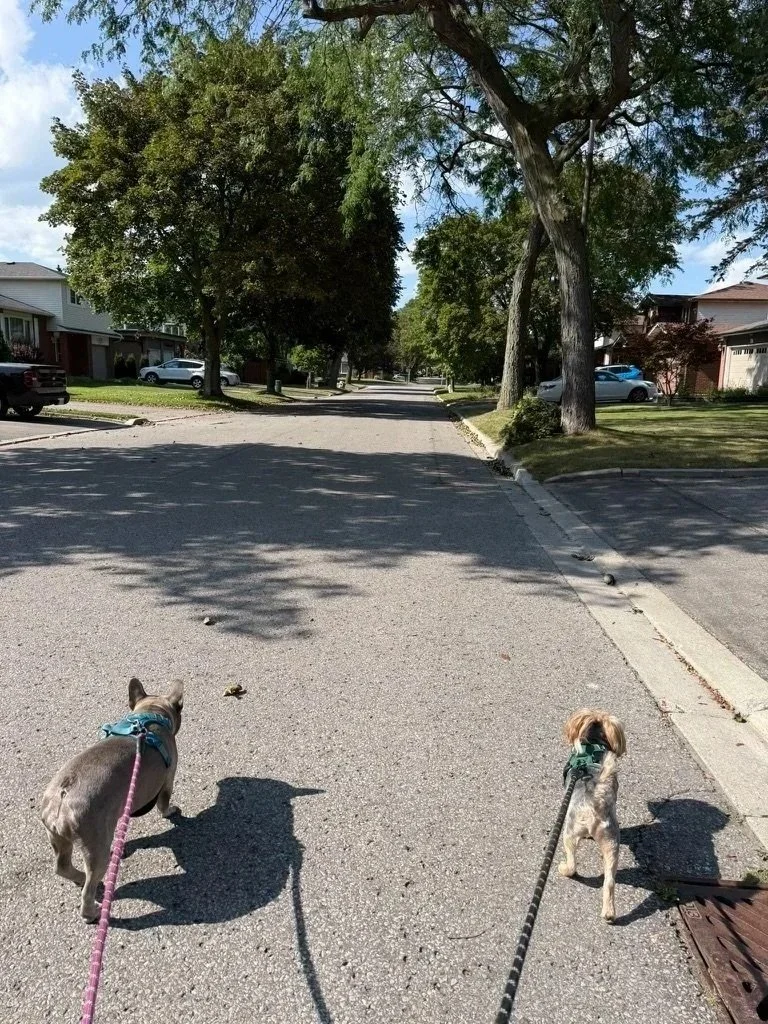
And on that note, it’s 4:00 p.m. The ground chuck that has been sitting in my fridge for two days needs to become burgers, and then I’m going to walk the dogs.
There is still work I could do. There always will be.
But this is the space between the spaces…and today, I’m going to let it belong to me.